OFDM
OFDM — Orthogonal frequency domain multiplexing
- Multiple carriers for one datastream
- Subcarriers are orthogonal
- There is a guard interval
The orthogonality requires that the subcarrier spacing is:
\( \Delta f = \frac{k}{T_U} \) Hz, where
\( k \) is a positive integer, typically equal to 1
\( T_U \) seconds, the useful symbol duration (the receiver-side window size)
This stipulates that each carrier frequency undergoes \( k \) more complete cycles per symbol period than the previous carrier.
Therefore, with \( N \) subcarriers, the total passband bandwidth will be \( B \approx N \cdot \Delta f \) (Hz).
Courtesy of Wikipedia.
What does this look like?
If \( \Delta f \) Hz is chosen correctly, transmitted signals look like this…
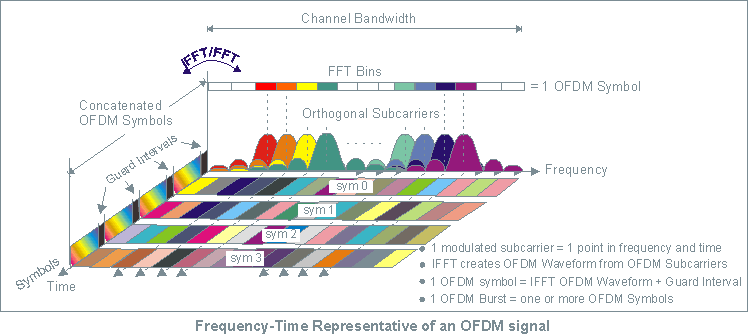
Image courtesy of Keysight.
- 8 subcarriers
- 1 OFDM symbol per unit interval
- Orthogonal signals eliminate crosstalk between subcarriers
Terms
- A waveform in the communication channel that persists for a period of time
Symbol Duration Time
- AKA, unit interval
- AKA, baud rate
\( T_s = \frac{1}{f_s} \)
FFT — Fast Fourier Transform
- Used to decode a recovered RF signal
IFFT — Inverse Fast Fourier Transform
- Used to encode a symbol into RF
References
Concepts of Orthogonal Frequency Division Multiplexing (OFDM) and 802.11 WLAN