gRPC
gRPC — gRPC Remote Procedure Call
gRPC allows writing network level apps using data in different places.
It’s a modern connection oriented, datastream.
Terms
BiDi — Bidirectional
Uses HTTP/2
- Multiplexing
- Header Compression
- Binary Framing
- Firewalls and proxies understand HTTP/2
Services
- Client - Server Oriented
- Streaming
- Blocking and non-blocking
- Flow control
- Protocol Buffers
- Message exchange
- gRPC clients talk to gRPC servers
- Uses HTTP/2 as transport
- Does not expose HTTP2 to the user
- Easily encrypted with TLS
- Persistent connections
- Heartbeats
- Uses application-level queue coalescence
Message Types
Programs can do remote function calls on other servers.
flowchart LR
%%{init: {'flowchart': {'curve': 'monotoneX'}}}%%
    subgraph cpp["C++ Service"]
        stub3["gRPC\nStub"]
    end

    subgraph ruby["Ruby Client"]
        stub1["gRPC\nStub"]
    end

    subgraph android["Android-Java Client"]
        stub2["gRPC\nStub"]
    end

    stub2 -->|"Proto Request"| cpp
    cpp -->|"Proto Response(s)"| stub2

    stub1 -->|"Proto Request"| cpp
    cpp -->|"Proto Response(s)"| stub1
Transaction Types
Unary
- One request
- One response
Client Streaming
- Client sends multiple messages
- Server sends one response
Server Streaming
- Client sends one request
- Server sends multiple messages
Bidirectional Streaming
- Two independent streams
- Any read or write order
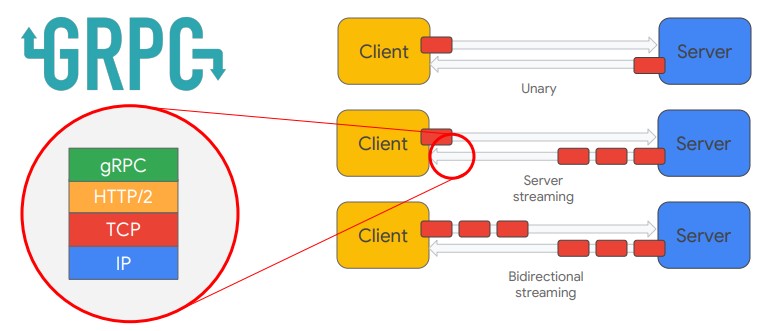
Image courtesy of Rob Shakir.
gRPC network applications
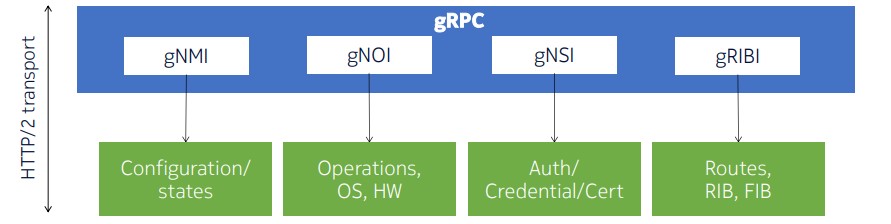
Image courtesy of Reda Laichi - NANOG 93.
Protocol buffers
This defines the data structure to send.
-
Small local records
-
Messages
-
end in
.proto
message Person {
  string name = 1;
  int32 id = 2;
  bool has_ponycopter = 3;
}
… Gets fed into the protocol buffer compiler protoc
Allows name(), set_name()
Now the Person class can serialize and retrieve protocol buffer messages.
References
gRPC - Motivation and Design Principles
gRPC - Core concepts, architecture and lifecycle
KubeCon 2018 - gRPC Introduction - Jayanth Kolhe
NANOG 93 - gRPC Services under one roof - Reda Laichi - Nokia